
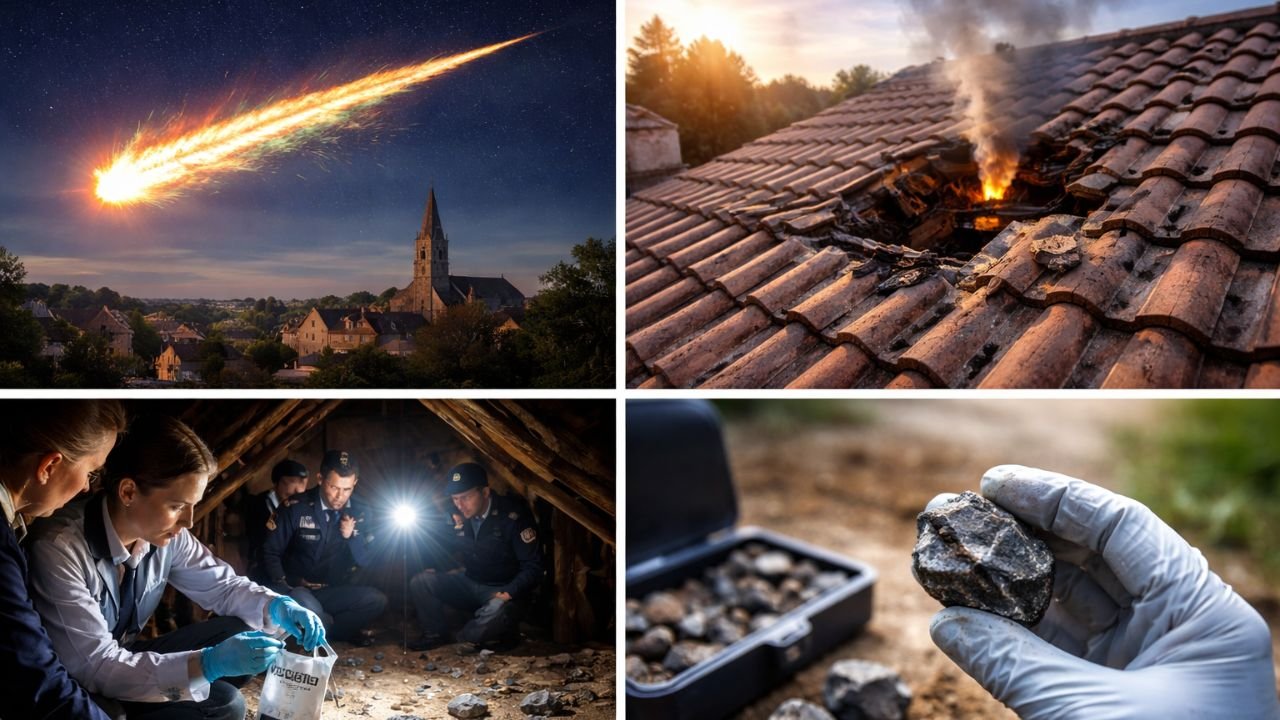
It began as a fleeting spectacle—an intense streak of light tearing across the night sky. Witnesses across parts of France described a glowing fireball, brighter than any shooting star, illuminating the darkness for just a few seconds. For most, it was a moment of wonder. For one household, it became something far more tangible.
Moments after the luminous trail faded, a sharp impact broke the silence. A fragment from space had completed its journey—not in a remote field, but through the roof of a home.
When a Meteorite Reaches the Ground
What streaked across the sky was not just a visual phenomenon, but a physical object known as a meteorite. Unlike meteors, which burn up in the atmosphere, meteorites survive the fiery descent and make contact with Earth.
In this case, fragments of the object endured the intense heat and pressure of entry, traveling at incredible speed before striking the building. The result was a rare and dramatic reminder that Earth is not isolated from the vast activity of space.
The Moment of Impact
Reports indicate that the object pierced the roof with surprising force, leaving behind a small but unmistakable entry point. Inside, debris scattered across the room, mixing earthly materials with something far more unusual.
The residents, startled but unharmed, quickly realized that this was no ordinary incident. The discovery of dark, dense fragments suggested a cosmic origin—pieces of rock that had traveled millions of kilometers before arriving unannounced.
A Rare but Real Event
While such events may seem extraordinary, they are not entirely unheard of. Thousands of small objects enter Earth’s atmosphere every year. Most burn up completely, creating the brief streaks of light commonly known as shooting stars.
However, only a tiny fraction survive as meteorites. Even fewer land in populated areas, and rarer still are those that strike man-made structures. The odds of a meteorite hitting a house are extremely low, making this incident particularly noteworthy.
The Science Behind the Fireball
The brilliant display observed across the sky is caused by friction between the object and Earth’s atmosphere. As the space rock travels at high speed, it compresses the air in front of it, generating intense heat and light.
This process creates what scientists call a bolide—a meteor so luminous that it can be seen over vast distances. The brightness and duration of the fireball often indicate the size and composition of the object.
In this case, the visibility across multiple regions suggests that the original object was relatively large before breaking apart during its descent.
From Space to Scientific Treasure
Once recovered, meteorite fragments quickly become objects of scientific interest. Researchers analyze their composition to learn more about the origins of our solar system.
Many meteorites are composed of ancient materials that have remained largely unchanged for billions of years. Studying them provides insights into planetary formation, cosmic chemistry, and even the building blocks of life.
For scientists, each recovered fragment is more than a curiosity—it is a piece of history older than Earth itself.
The Human Fascination with Falling Stars
Events like this capture the imagination because they blur the line between the distant cosmos and everyday life. A meteorite is not just something observed through a telescope—it is something that can, quite literally, land at your doorstep.
This sense of connection fuels a long-standing fascination with space. From ancient myths to modern science, falling stars have always held a special place in human culture.
The idea that something from beyond our planet can suddenly appear in our immediate surroundings adds an element of mystery and wonder that few other phenomena can match.
Risks and Realities
Despite the dramatic nature of this घटना, the actual خطر posed by meteorites remains extremely low. The vast majority of Earth’s surface is uninhabited, and most incoming objects disintegrate before reaching the ground.
Even when meteorites do land, they are usually small and cause minimal damage. Incidents involving direct hits on buildings or people are exceptionally rare.
Nevertheless, such events serve as a reminder of the dynamic environment in which our planet exists. Space is not static—it is filled with motion, debris, and constant activity.
A Story That Travels Far
The recovery of meteorite fragments from this event has sparked widespread interest, both locally and internationally. News of the incident quickly spread, drawing attention from scientists, collectors, and curious observers alike.
For the residents involved, the experience is likely to remain unforgettable—a moment when the ordinary was interrupted by the extraordinary.
For others, it is a story that reinforces the unpredictability of nature and the vastness of the universe.
When the Sky Comes Closer
In the end, this घटना is more than just a scientific घटना—it is a reminder of our place in the cosmos. The boundary between Earth and space is not as distant as it sometimes seems.
A single fireball, lasting only seconds, can bridge that gap in the most dramatic way possible.
As fragments of this celestial visitor are studied and preserved, they carry with them a story that began far beyond our world. And for a brief moment, that story intersected with everyday life—leaving behind not just a hole in a roof, but a lasting sense of wonder.